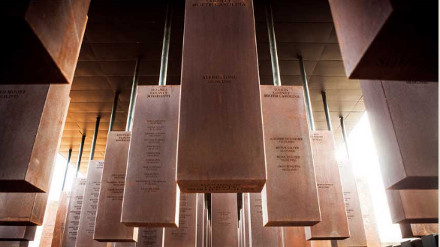
National Memorial for Peace and Justice
The questions that follow are intended to be helpful as a general guide to the experiences and learning that the Sites provide.
“The Memorial is the first comprehensive memorial dedicated to thousands of victims of racial terror lynchings between 1877-1950.”
Key Questions :
- Reflect on the Memorial’s extensive text descriptions of racial terror lynching early in the Site.
- Why is such a historical explanation important and necessary?
- Why is such a historical explanation important and necessary?
- Explore the significance of a new section of the Memorial that identifies over 120 community coalitions that have partnered with EJI by responding to the call to reckon with the history of racial violence locally and erect memorials to honor, remember, and acknowledge victims.
- Why is this movement of truth telling so important?
- Explore the significance of a new section of the Memorial that identifies over 120 community coalitions that have partnered with EJI by responding to the call to reckon with the history of racial violence locally and erect memorials to honor, remember, and acknowledge victims.
- Why is this movement of truth telling so important?
- Why is this movement of truth telling so important?
Additional Reflection:
- Reflect on the meaning and implications of the quotation by Dr. Martin Luther King Jr. at the entrance: “True peace is not merely the absence of tension. It is the presence of justice.”
- Why is it important for the Memorial to feature Toni Morrison’s passage from Beloved, a reflection space for Ida B. Wells, “Guided by Justice” by Dana King, and “Rise Up” by Hank Willis Thomas? Taken together, how do these works suggest the Black community’s response to terror?
- How does the Memorial’s exploration of racial terror lynching differ from the Legacy Museum’s study of this era? How do the sites complement one another?
Curated by EJI Education Department
#DeltaRemembers